20 luglio 2017
Marconi, non solo inventore ma anche leader scientifico. A 80 anni dalla morte
Ottanta anni fa, il 20 luglio 1937, fa moriva Guglielmo Marconi, il padre della radio. L'uomo che ha cambiato il nostro modo di vivere dalla radio alla televisione, dal telefonino al wifi...
Fu un grande scienziato che credette fino in fondo nella sua creatura, la radio, sfidando tutto e tutti. Ma fu anche un eccellente organizzatore scientifico. Con lui come presidente, il CNR conobbe nuova vita e la ricerca scientifica in Italia ne ricevette un grande impulso, anche se non mancarono le invidie e i bastoni tra le ruote...
Invito chi fosse interessato a leggere un mio articolo sul sito Avvenire.it CLICCA QUI
14 giugno 2017
Le prime immagini del nuovo SDR Airspy HF+
Ecco le prime immagini del nuovo Airspy HF+ in arrivo nelle prossime settimane. Di fatto si tratta di un rendering
Di questo ricevitore a 18 bit con caratteristiche davvero interessanti ma a un prezzo decisamente abbordabile (si parla di poco più di 200 euro) abbiamo già parlato tempo fa.
Ecco un paio di link per avere maggiori informazioni
In italiano: Radio & Communication Info CLICCA QUI e anche QUI
In Inglese Airspy HF+ page RTL-SDR CLICCA QUI
25 maggio 2017
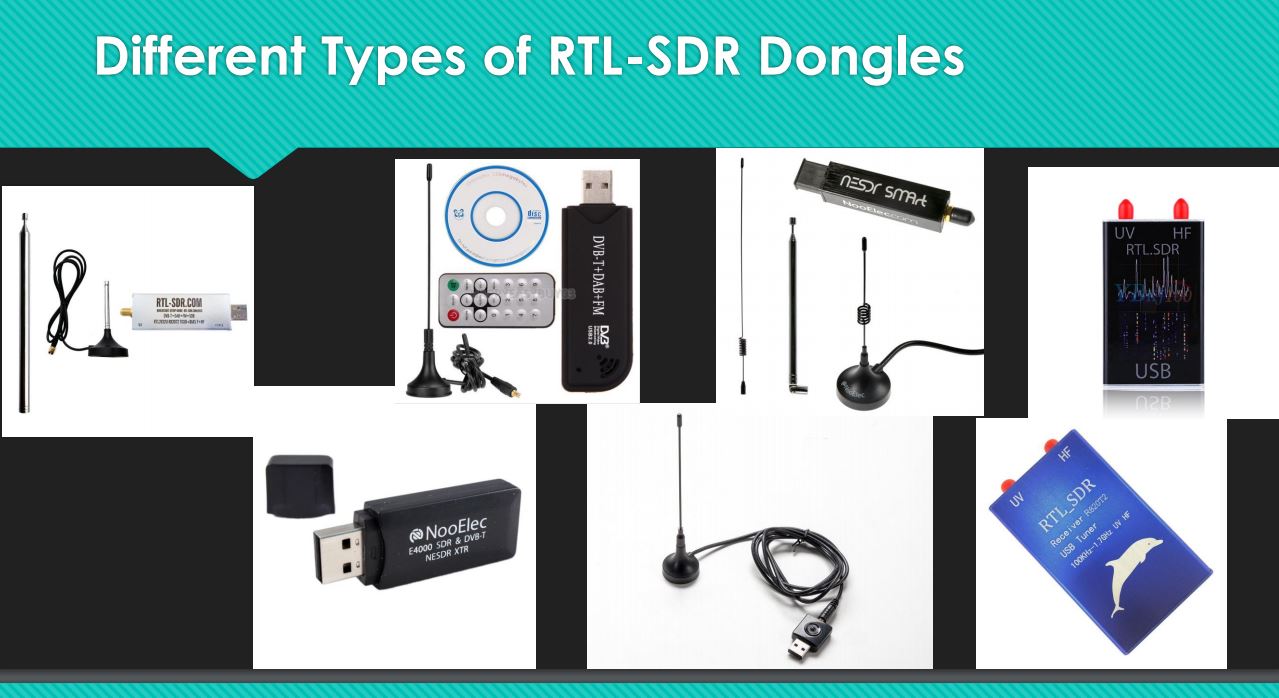
Chiavette RTL-SDR: per saperne di più su uso e potenzialità
| Dal sito RTL-SDR.com |
Detto ciò ci sono davvero tante cose da sapere e imparare. Almeno per molti di noi...
Consiglio quindi di dare un occhio a tre presentazioni in PDF presentate alla 2017 Hamvention da Carl Laufer, patron del sito RTL-SDR.com (un mast per gli appassionati del genere). Si possono scaricare gratuitamente, quindi non possono far male!
1) The World Of Low Cost Software Defined Radio
Una panoramica delle chiavette SDR nelle varie utilizzazioni: dai satelliti al traffico aereo, dalla radioastronomia alla sicurezza del pc, dal GPS alla ricerca dei disturbi.
2) An Introduction to RTL-SDR
Un'introduzione al mondo dei ricevitori RTL-SDR e le applicazioni più comuni
3) Introduction to Cheap SDRs for Radio Monitoring
Una breve introduzione al RTL-SDR e una selezione di alcuni modi digitali che possono essere ricevuti
Infine consiglio di dare un occhio alla pagina About RTL-SDR
13 maggio 2017
Antenne per bande basse (anche con poco spazio)
Qualche riflessione pratica sulle antenne, in particolare per le bande basse. Due video e un pdf. Il tutto ripreso da SWB (Short Wave Bullettin)
Low band rx antennas
Waller Flag RX Antenna 101- How to Construct a Waller Flag.
Jose Carlos (JC), N4IS, will look at basic concepts of RX antennas and share his experiences with lowband RX ant... N4IS discusses lowband receiving principals and construction of the Horizontal Waller Flag:
High Performance RX Antennas for a Small Lot
Jose Carlos (JC), N4IS, will look at basic concepts of RX antennas and share his experiences with lowband RX antennas on a small lot, including the Waller Flag. (South Florida DX Association - Don’t need to move out in the woods, just improve your receiving system and enjoy the good stuff).
This pdf-file concentrate the Powerpoint presentation "High Performance RX Antennas for a Small Lot" of Jose Carlos (JC), N4IS to a presentation of only 51 pages.
CLICCA QUI PER SCARICARE IL PDF
Low band rx antennas
Waller Flag RX Antenna 101- How to Construct a Waller Flag.
Jose Carlos (JC), N4IS, will look at basic concepts of RX antennas and share his experiences with lowband RX ant... N4IS discusses lowband receiving principals and construction of the Horizontal Waller Flag:
High Performance RX Antennas for a Small Lot
Jose Carlos (JC), N4IS, will look at basic concepts of RX antennas and share his experiences with lowband RX antennas on a small lot, including the Waller Flag. (South Florida DX Association - Don’t need to move out in the woods, just improve your receiving system and enjoy the good stuff).
This pdf-file concentrate the Powerpoint presentation "High Performance RX Antennas for a Small Lot" of Jose Carlos (JC), N4IS to a presentation of only 51 pages.
CLICCA QUI PER SCARICARE IL PDF
12 maggio 2017
Come usare il software SDRuno: video corso di SDRplay
| Qui si spiega come lavorare in banda FM con SDRuno |
SDRuno, derivato da Studio1, è il software gratuito ufficiale dei ricevitori SDRplay RSP1 e RSP2 (vai al sito ufficiale) che può essere utilizzato anche con le chiavette SDR da pochi euro.
| I ricevitori SDRplay 1 e SDRplay 2 |
Un lavoro prezioso realizzato con pazienza professionale da Mike Ladd, che ha cercato di affrontare una lunga lista di argomenti: dall'uso del virtual audio cable alla calibrazione, dalla noise reduction all'uso dell'RDS sulla banda FM... Consigliato anche da RTL-SDR.com
Il primo video della serie tutorial. Clicca e inizia il corso:
26 aprile 2017
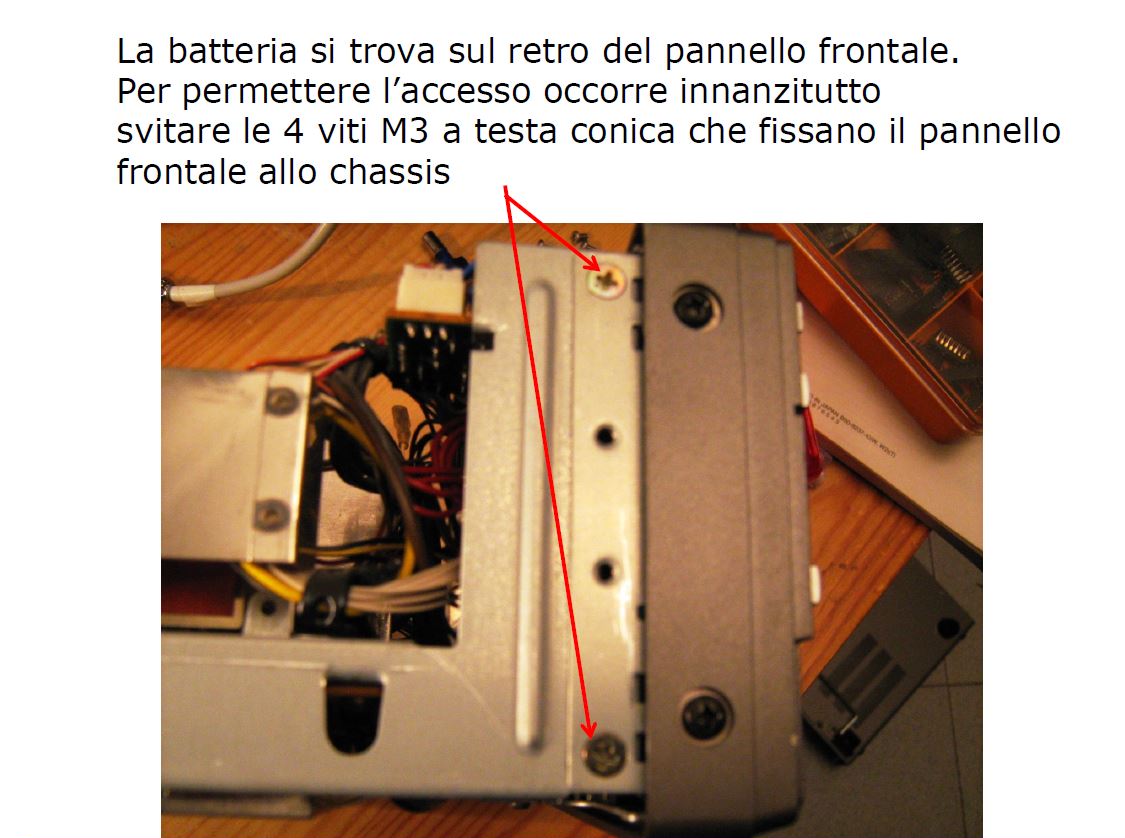
Come sostituire la batteria al mitico Kenwood R-5000
Come sostituire la batteria al Kenwood R-5000
By Giovanni Carboni IZ5PQT
A me la batteria originale è durata 20 anni. Vedremo questa! 73
By Giovanni Carboni IZ5PQT
Prima di tutto occorre rimuovere i coperchi inferiore (9 viti) e superiore (8 viti) e sconnettere l'altoparlante interno
A me la batteria originale è durata 20 anni. Vedremo questa! 73
25 aprile 2017
Come ti rimetto in funzione il Lowe SRX-30
di Michele D'Amico IZ2EAS
Sabato 01 aprile 2017
La radio si accende ma non riceve nulla, solo il soffio in BF. Il problema è il divisore x10 TTL 7490PC, guasto; sono infatti scomparse le “righe” ogni MHz e sono presenti solo multipli di 10 MHz (il master clock). Questo guasto è tipico, è la seconda radio (su due che ho riparato) di questa famiglia che presenta questo problema. Sostituito con il più moderno 74LS90, montato su zoccolo. La radio ora funziona perfettamente. Riallineato l’oscillatore a cristallo da 10 MHz.
Domenica 02 aprile 2017
Riallineato il VFO e la IF “tracking” 2-3 MHz, seguendo il service manual del Drake SSR1, molto preciso e dettagliato (le due radio sono praticamente identiche).
Riallineata la IF a 455 kHz, iniettando il segnale del generatore R&S sulla base di Q9 (come da service manual del SSR-1). La risposta è asimmetrica in AM ma abbastanza simmetrica in LSB/USB.
Ho ritarato leggermente il BFO: frequenza USB 454.1 kHz, frequenza LSB 457.2 kHz, corrispondente ad uno shift tra i due modi di circa 3 kHz.
Rimosso un circuito “estraneo” nella linea di alimentazione a 12 V esterni, uno stabilizzatore di tensione a transistor che un “sarchiaponatore” misterioso aveva introdotto. Sostituito con un semplice diodo di “non ritorno”, 1N4002 (100V, 1A).
Lubrificati tutti i meccanismi rotanti. Disossidati i commutatori. Pulizia generale e derattizzazione.
(Fusibile installato: 1 A Fast grande, corretto)
Al termine del lavoro la radio suona come un violino !
07 aprile 2017
Modifica allo Yaesu FRG-7000: filtro stretto anche in AM
Yaesu FRG-7000: a modification to use the narrow filter in AM mode
(by Michele D’Amico IZ2EAS)
Introduction
The Yaesu FRG 7000 is a colorful, vintage receiver that is still fun to use. The main drawback when used in AM mode is the availability of only one IF bandwidth, that is way too wide (9kHz at –6dB, measured) in crowded band conditions (What ? “Crowded bands” in 2017 ?). The narrow filter (2.8 kHz at – 6dB) is accessible only in USB/LSB modes.
However, this limitation can be overcome with a very simple modification, that is absolutely not-invasive and completely reversible. With this modification when you select the AM mode the receiver uses the Wide Filter, while when you select the AM-ANL mode the receiver uses the Narrow Filter.
But first let me state it very clearly: do it at your own risk. I will accept no liability for any damage you will do to your radio, to yourself or to this sector of the Universe by following the procedure outlined in this document.
Please feel free to contact me if you want to exchange ideas at: iz2eas(AT)gmail.com
The mod
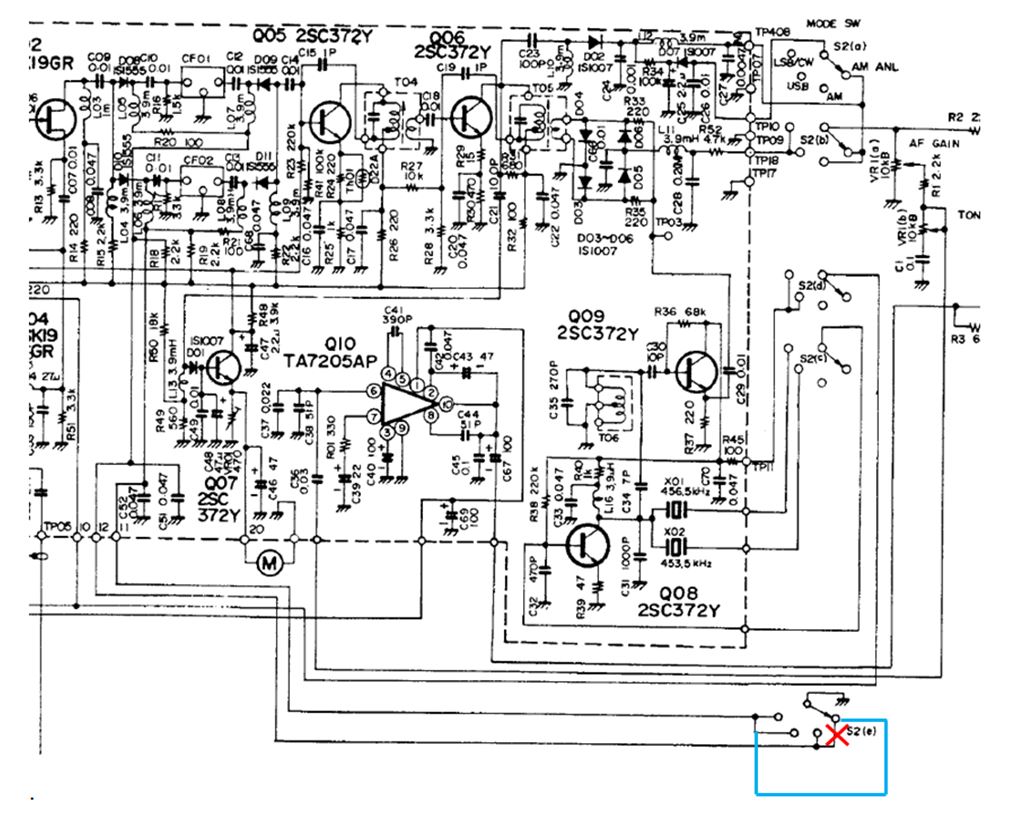
Since the filters are selected electronically by activating a diode, the modification is very simple: just “cut” a connection on the “mode” switch and rewire it. This will allow you to select the Narrow Filter in AM-ANL mode, while the standard AM mode uses the Wide Filter.
The mode switch is easily accessible from underneath the radio, there is no need to dismount anything apart removing the receiver’s cover; the photo below shows the position of the mode switch (circled in red).


In the schematic below the modification is shown: just “cut” a connection (red cross) on S2(e) switch and rewire it with the blue wire. The section (e) of switch S2 select the desired IF filter (CF01 –wide- or CF02 –narrow-) by grounding a diode (and hence activating it).
As standard, CF01 is selected for AM and AM-ANL modes, and CF02 for USB and LSB modes. By rewiring section (e), we activate CF01 only for AM, and CF02 for USB/LSB/AM-ANL; as simple as that !
Please note that I kept the ANL circuit operative, since I could hardly notice its effect; if you want, you can disable it but then the modification will be more invasive and you will need to rewire also section (a) of S2.
On the left the band switch before the mod. The connection that need to be interrupted is the one circled in blue, easily accessible, where the white-and-blue wire is connected.
There is no need to dismount the switch.
The two pins of the switch are soldered together; I cut the wire and then used a de-soldering pump to remove the solder and separate them. See:
On the right the band switch after the mod. Note the added green wire that jumpers the fourth (and last) pin of the switch (AM-ANL position) to the first and second pins (USB/LSB position), i.e. to the white-and-brown wire.
The white-and-blue wire is now connected only to the third pin (AM position). See:
03 aprile 2017
Nuovo ricevitore SDR Airspy HF+: informazioni ufficiali
Non molto tempo fa avevo annunciato l'arrivo del nuovo ricevitore SDR Airspy HF+ (Clicca qui per leggere). Adesso è comparsa anche una pagina sul sito del produttore, pagina che però non riporta alcuna immagine.
Si spiega però la filosofia costruttiva del nuovo ricevitore con tutta una serie di informazioni utili per gli appassionati. Vi consiglio di dare un occhio a questa pagina: CLICCA QUI
Le specifiche tecniche fornite appaiono molto interessanti:
HF coverage between DC .. 31 MHz
VHF coverage between 60 .. 260 MHz
-138 dBm MDS at 500Hz bandwidth in HF
-142 dBm MDS at 500Hz bandwidth in VHF
+26 dBm IIP3 on HF at maximum gain
+13 dBm IIP3 on VHF at maximum gain
110 dB dynamic range in HF
95 dB dynamic range in VHF
120 dB Image Rejection
Very low phase noise PLL (-110 dBc/Hz @ 1kHz separation @ 100 MHz)
+10 dBm Maximum RF input
No Silicon RF switch to introduce IMD in the HF path
Routable RF inputs
Wide Band RF filter bank
Tracking RF filters
Sharp IF filters
Smart AGC with real time optimization of the gain distribution
All RF inputs are matched to 50 ohms
2 x High Dynamic Range Sigma Delta ADCs @ up to 36 MSPS
600 kHz alias and image free output
18 bit Digital Down Converter (DDC)
0.5 ppm high precision, low phase noise clock
4 x Programmable GPIO’s
No drivers required! 100% Plug-and-play on Windows Vista, Seven, 8, 8.1 and 10
Industrial Operating Temperature: -45°C to 85°C
29 marzo 2017
ColibriNANO: nuovo ricevitore SDR. Ben oltre una chiavetta
Un periodo di annunci e di attesa per gli appassionati. Nuovi SDR si affacciano sul mercato. Ricevitori con caratteristiche e prezzi piuttosto diversi. Fatto positivo, in quanto si allargano le possibilità d scelta per noi appassionati.
Ecco quindi un nuovo arrivo: Il ColibriNANO, ricevitore SDR formato chiavetta ma a 14 bit
Sembra una chiavetta ma è di livello decisamente superiore. Copre dai 10 kHz ai 500 MHz (dai 55 ai 500 MHz in oversampling). Presenta 110 dB di blocking dynamic range e visualizza fino a 3 MHz di banda. Il produttore parla di sensibilità molto elevata (vedi sotto le specifiche).
Girerà sotto Windows (da XP a 10), Linux e con gli Web client for i browser HTML5. Inoltre è pienamente compatibile, secondo il produttore, con alcuni programmi ormai classici e gratuiti: HDSDR e SDR#. Inoltre è compatibile con ExpertSDR2
Il ricevitore ColibriNANO sarà in vendita verso la fine di aprile al costo di 299 euro
Trovate la "descrizione ufficiale" sul sito del produttore: Pileup Sunsdr
Da notare, tra l'altro: The ColibriNANO features a Texas Instruments ADS4145 14 bit direct sampling ADC and a built in low 55 MHz pass filter that can be bypassed to receive signals up to 500 MHz (external filters like the our 2m filtered preamp recommended).
Specifiche:
Ecco quindi un nuovo arrivo: Il ColibriNANO, ricevitore SDR formato chiavetta ma a 14 bit
Sembra una chiavetta ma è di livello decisamente superiore. Copre dai 10 kHz ai 500 MHz (dai 55 ai 500 MHz in oversampling). Presenta 110 dB di blocking dynamic range e visualizza fino a 3 MHz di banda. Il produttore parla di sensibilità molto elevata (vedi sotto le specifiche).
Girerà sotto Windows (da XP a 10), Linux e con gli Web client for i browser HTML5. Inoltre è pienamente compatibile, secondo il produttore, con alcuni programmi ormai classici e gratuiti: HDSDR e SDR#. Inoltre è compatibile con ExpertSDR2
Il ricevitore ColibriNANO sarà in vendita verso la fine di aprile al costo di 299 euro
Trovate la "descrizione ufficiale" sul sito del produttore: Pileup Sunsdr
Da notare, tra l'altro: The ColibriNANO features a Texas Instruments ADS4145 14 bit direct sampling ADC and a built in low 55 MHz pass filter that can be bypassed to receive signals up to 500 MHz (external filters like the our 2m filtered preamp recommended).
Specifiche:
- Receiving bandwidth: 0.1 – 55 MHz
- Oversampling receiving: 0.1 – 500 MHz
- Blocking Dynamic Range (BDR): 110 dB
- Sensitivity: 0.05 uV at 20M band, preamp = 0
- IMD3 Dynamic Range: 95 dB
- ADC resolution: 14-bit @ 122.88 MHz
- Sample rate: 48, 96, 192, 384, 768 kHz and 1.5, 3.0 MHz
- IQ resolution: 24 bit (16 bit at 1.5 and 3 MHz sample rates)
- RF Input: (SMA connector, up to 15kV ESD protection)
- Preamp range: from 31.5 up to +6 dB with 0.5 dB steps
- Operating temperature: -10°C to 60°C
- Dimensions: 90х25х17mm
- Weight: 0.043kg
Un articolo (a cui ne faranno sicuramente seguito altri) lo travate sul sito RTL-SDR.COM
Iscriviti a:
Post (Atom)